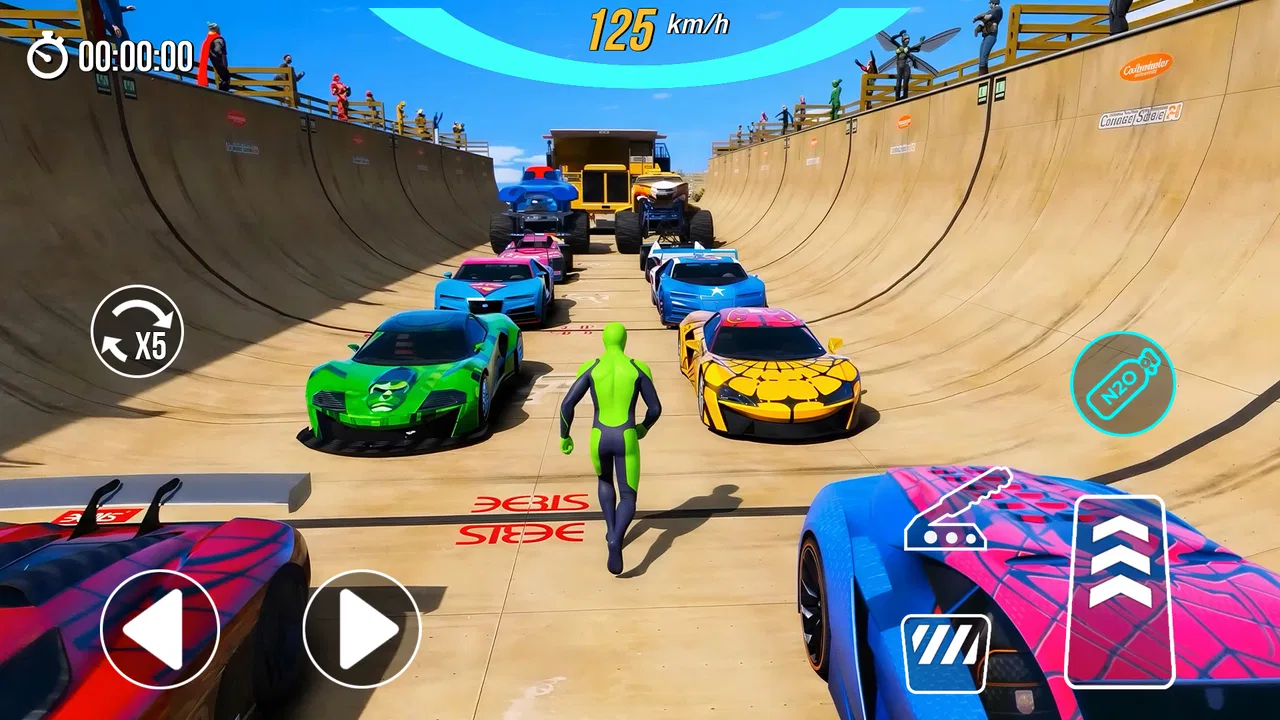
Big Ramp Jump - Super Car Race
- 4.5
- Rating
- 5.00M
- Installs
- Free
- Price

 Analysis by App-foxy
Big Ramp Jump - Super Car Race is the kind of driving game I open when I want immediate action rather than a long career mode or a realistic racing lesson. Its whole appeal is built around taking a supercar toward oversized ramps, launching into the air, and trying to keep each stunt under control. That simple idea gives it a clear identity within the simulation category: it is less about copying real driving and more about making each jump feel like a small decision.
I spent time treating it as more than a quick novelty. The important question is not only whether the car can reach a ramp, but whether I approach the jump with enough control to make the landing useful. A reckless attempt can look impressive and still leave the car badly positioned. A slower, more deliberate run often produces the better result. That balance is what makes the game easier to recommend to someone who enjoys short sessions and visual stunts.
Big Ramp Jump - Super Car Race is free, developed by SpeedZone, and aimed at Everyone. It has reached more than five million installs and holds a 4.5 average from around six thousand ratings, which suggests that its straightforward stunt-driven format has found a sizeable audience. It was released on December 11, 2024, and the current version is 1.3.1, with support beginning at Android 6.0.
You May Also Like

 Blood Strike: 2.5 Anniversary
Blood Strike’s Loadouts Turn Every Drop Into a Tactical Gamble
A close look at Blood Strike’s custom loadouts: how fast access to signature weapons reshapes its battle royale rhythm, rewards preparation, and narrows the gap between fights.

 Pandora - Music & Podcasts
Pandora’s Music Is Easy to Start, but Harder to Recover
Pandora’s strength is its low-effort path from a seed to a station. Its weak spot is how much confidence it asks you to place in connection, setup, and quiet recovery.

 8 Ball Pool
 Is Built on Rivalries, Rematches, and Routine
A close look at the rivalries, rematches, shared routines, and unanswered safety questions that turn a quick pool match into a persistent mobile community.

 Samsung Music
’s Quiet Strength Is Playing What You Already Own
Its reach comes less from spectacle than from dependable access to a personal library. That simplicity is both the app’s strongest retention engine and its ceiling.

 AccuWeather: Weather Radar
AccuWeather Review: A Quick, Clear Forecast for Everyday Decisions
For everyday plans, the best forecast is the one you can understand quickly. AccuWeather makes rain timing, radar, and local conditions easy to act on, with a few trade-offs.

 Hill Climb Racing
Why Hill Climb Racing Still Turns Crashes Into One More Run
A tiny car, a bumpy hill and one more upgrade: Hill Climb Racing keeps resurfacing because its simple chaos makes every near-miss feel personal.
More From Our News Desk



Reading the track before committing to a jump
The first useful habit is to stop thinking of every ramp as a command to accelerate as hard as possible. In my experience, the approach matters more than the spectacle. A car that arrives too quickly may leave the ramp at an awkward angle, while a cautious approach can make the landing much easier to manage. The game works best when I read the visible route as a sequence instead of treating each stunt as an isolated button press.
That creates a modest but meaningful decision space. Before a jump, I consider whether I want maximum height, a stable landing, or simply enough momentum to continue. Those goals are not always compatible. Going for height may make the car harder to align afterward, while prioritizing a clean landing can make the attempt look less dramatic. The right choice depends on what the next section demands, so I try to plan one movement beyond the ramp itself.
This is also where the game differs from a conventional circuit racer. In a normal racing game, the safest line is usually the fastest line around a corner. Here, the safest line may not be the most entertaining, and the most spectacular line may create more trouble afterward. The track becomes a small puzzle of speed, angle, and recovery. I found that especially enjoyable when I resisted the urge to repeat the same full-speed approach.
For new players, I recommend using the early attempts to learn the car’s response rather than chasing a perfect stunt immediately. Notice how quickly the vehicle changes direction, how much correction is possible in the air, and how forgiving the landing feels. Those observations are more useful than simply memorizing a sequence. Once I understood the rhythm of approach, launch, adjustment, and landing, the tracks became less chaotic.
A practical everyday scenario shows where this game fits. If I have a short break while waiting for an appointment, I can start a session without needing to remember a complicated story or rebuild a large setup. I can make a few attempts, learn from a bad landing, and stop without feeling that I have abandoned a long campaign. That convenience is a genuine strength, particularly for players who prefer compact bursts of play.
Why the camera and timing matter
Stunt games can become frustrating when the player cannot judge distance or orientation. Here, I pay close attention to the car’s position before the ramp rather than focusing only on the jump itself. The final moments of the approach are often where a run is won or lost. A small directional correction made too late can turn a centered launch into a sideways one.
My preferred routine is to make one exploratory attempt, then change only one thing on the next run. I might reduce the approach speed, alter the angle, or aim for a different landing position. Changing everything at once makes it impossible to understand what helped. This simple testing method gives the game more depth than its short description suggests and prevents repeated failures from feeling completely random.
Players who want a traditional race against opponents may find this structure unusual. There is no need to compare every moment with another driver’s pace in the way I would in a standard racing title. The pressure comes from controlling the stunt and recovering from it. That makes the game more personal and mechanical, but it also means the experience may feel thin to anyone expecting a full racing simulation.
Risk, reward, and the cost of showing off
The most entertaining part of the game is also the source of its main tension: the bigger the stunt I attempt, the more opportunities I create for a poor landing. A conservative run can feel uneventful, but it usually gives me a better chance of continuing. A dramatic launch is satisfying when it works, yet the failure is more noticeable because I chose the risk knowingly.
I like that trade-off because it gives each attempt a small narrative. I can decide to play safely after a few mistakes, or I can keep pursuing a more ambitious jump because the previous failure revealed something about the route. The game does not need a complex economy to make this choice interesting. The reward is the feeling of finally making a sequence work after identifying the reason it failed.
One non-obvious lesson is that landing position can matter more than airtime. A high jump may look successful, but if the car touches down near the edge or points away from the next section, the result is not truly useful. I now judge a stunt by what happens immediately after contact with the track. That change in perspective made me less impressed by flashy attempts and more satisfied by controlled ones.
Another useful approach is to separate practice from performance. During practice, I deliberately try slightly different speeds and angles, even when I suspect they may fail. During a serious attempt, I return to the approach that gave me the cleanest recovery. This avoids wasting every run on the same safe method while still giving me a reliable option when I want to finish a section.
The trade-off is that the game’s reward structure may feel limited for players who need constant progression. Its appeal comes from improving execution and enjoying the stunt itself, not from a deep management layer. If I want vehicle tuning, detailed race strategy, or a long list of objectives, I would choose a more traditional racing game. If I want a quick challenge centered on ramps and control, this narrower focus works in its favor.
When the safe line is the smart line
I found it tempting to treat every wide ramp as an invitation to use maximum speed. That is usually the wrong instinct. A controlled entry gives more time to correct the car and makes the landing easier to read. The safer line is not always visually impressive, but it often produces a more repeatable result, which matters when I am trying to learn rather than merely entertain myself.
This also helps answer a question many new players have: should the game be played aggressively or carefully? My answer is to begin carefully, then add risk once the route feels familiar. Aggression is more useful after I understand the consequences of a jump. Starting with reckless speed can hide the real problem, because a failed attempt may be caused by poor alignment rather than insufficient momentum.
For younger players or anyone who prefers uncomplicated controls, the Everyone rating makes the game approachable in terms of audience. Still, approachable does not mean every stunt is instantly easy. The challenge comes from timing and judgment, so a player who dislikes repeating attempts may lose patience. I would recommend it to someone who enjoys learning through trial and error, not to someone looking for a completely relaxed drive.
Adapting instead of repeating the same mistake
The game becomes more enjoyable when I treat failure as information. If the car leaves the ramp at an angle, I ask whether the approach was misaligned or whether I corrected too late. If the landing looks clean but the car cannot continue, I reconsider the target rather than blaming the jump itself. This mindset turns a failed run into a useful test and gives the tracks a stronger sense of structure.
Adaptation is especially important because stunt routes punish habits that work in ordinary racing games. In a circuit racer, hugging a corner and carrying speed can be a dependable technique. In this game, carrying that same speed into a ramp may reduce control. I have to replace the instinct to preserve momentum with a more flexible question: what speed gives me the best launch and the best chance of being ready afterward?
A concrete workflow that helped me was to use three phases. First, I approach the ramp while focusing on alignment. Second, I make only small corrections during the jump instead of panicking. Third, I prepare for the landing before the wheels touch down. That last phase is easy to overlook. Waiting until the car has landed to think about direction often means the recovery window has already disappeared.
I also recommend changing the goal when a section becomes frustrating. Rather than trying to make the biggest possible jump, aim for a repeatable landing. Once that works, increase the ambition gradually. This creates a personal progression system even when the game is not being played as a conventional campaign. It is a useful way to keep short sessions productive instead of ending after a string of identical crashes.
The limitations become clearer during longer sessions. The central stunt idea is strong, but it can feel repetitive if I expect every attempt to introduce a completely new kind of challenge. The game is better suited to focused bursts than to marathon play. After I have been playing for a while, I prefer to pause and return later, when the simple act of lining up a jump feels fresh again.
Who will enjoy the learning curve
I think the best audience is someone who enjoys arcade-style driving, exaggerated ramps, and the satisfaction of improving a physical sequence. It is also a good fit for players who want a free game that can be understood quickly without committing to a large racing ecosystem. The visual idea is easy to grasp, but the difference between a messy jump and a controlled one gives experienced players something to refine.
I would skip it if my main goal were realistic vehicle behavior, detailed customization, competitive multiplayer, or a broad collection of racing formats. Those expectations point toward a different type of game. This one is intentionally focused on supercar stunts, and its narrow purpose is both its charm and its limitation. It does not need to replace a full racing game, because it offers a different kind of driving satisfaction.
The free price lowers the barrier to trying it, but it does not remove the need for patience. A player can start without paying, yet the real value comes from deciding whether repeated practice is enjoyable. I would not judge it after a single failed attempt. The game makes more sense once I have adjusted my approach and seen how much control improves when I stop treating every ramp as a speed test.
Depth over time: what keeps it interesting
Big Ramp Jump - Super Car Race does not create depth through complicated systems. Its longer-term appeal comes from execution, route reading, and the personal challenge of making a stunt consistent. That may sound modest, but it is enough for a certain kind of player. I enjoy returning when I remember a section that felt almost manageable and want to test whether a better approach solves it.
The most valuable improvement is not simply learning to launch farther. It is learning to recognize the kind of mistake I am making. A speed error, an alignment error, and a landing error require different responses. Once I separated those problems, I stopped making random adjustments. That is the kind of knowledge that carries from one attempt to the next and gives the game a more satisfying learning curve.
There is also a useful distinction between a spectacular success and a reliable success. A spectacular success may happen once through a fortunate correction. A reliable success can be repeated because the approach is understood. I value the second more. It gives me confidence to experiment later, and it makes the game feel less dependent on luck.
For short-session players, I suggest setting a small goal before starting: complete one section cleanly, improve the landing angle, or reproduce a jump that previously worked. This keeps the session focused. Without a goal, it is easy to accelerate into another attempt simply because the game makes restarting feel inviting. With a goal, even a brief play period can feel like genuine progress.
The current version, 1.3.1, is the version I would look for when installing, and the minimum Android requirement of 6.0 keeps it accessible to devices that are not especially new. I still consider the individual phone important for comfort, since stunt games depend on seeing the car’s position clearly and reacting at the right moment. A cramped display or awkward control setup can make precise corrections less pleasant.
Its rating and install history make it easier for me to recommend as a low-risk experiment, but popularity should not be confused with universal appeal. The game’s focused design means some players will finish their curiosity quickly. That is acceptable for a title built around immediate stunt action. I would rather see it deliver one clear idea well than add unrelated systems that distract from the ramps.
My strategy verdict
My final view is that Big Ramp Jump - Super Car Race succeeds when I play it as a compact stunt challenge rather than as a complete racing simulator. The strongest moments come from making a decision before the ramp, accepting the risk of the launch, and adapting when the landing reveals a problem. That loop is simple, but it gives the game a recognizable personality.
I recommend starting with controlled approaches, studying where the car lands, and changing one variable at a time. Do not judge a jump only by height or visual drama. Ask whether the car is positioned well enough to continue. That single habit improves the experience and exposes the game’s most interesting layer: the difference between doing something spectacular and doing it successfully.
For a friend who wants a free, accessible Android simulation game for quick sessions, I would suggest giving it a try, especially if oversized ramps and supercar stunts sound more appealing than realistic laps. I would set expectations clearly, though. This is not the right choice for deep customization, serious competition, or a long-form racing career. Its value is in focused repetition, immediate feedback, and the small strategic decisions hidden inside each jump.
In the end, SpeedZone has built a game around a narrow idea and lets that idea carry the experience. When I want a quick break with a clear objective and room to improve my control, it does the job well. When I want variety, realism, or a broader progression system, I reach for another racing option. That honest division is why I find this one worth recommending: it knows what kind of driving game it wants to be, and the best results come when I play it on those terms.
FAQs for Big Ramp Jump - Super Car Race
01What is Big Ramp Jump - Super Car Race?
Big Ramp Jump - Super Car Race is an arcade-style driving game focused on launching powerful cars from enormous ramps and performing spectacular jumps. Instead of offering a realistic racing simulation, it emphasizes speed, stunt action, crashes, and entertaining landings. Players generally progress through increasingly challenging tracks, improve their vehicles, and try to complete jumps or reach the finish while avoiding obstacles and failed landings.
02How is the gameplay in Big Ramp Jump - Super Car Race?
The gameplay is designed to be simple to learn, making it suitable for short play sessions. You control the vehicle’s acceleration, direction, or balance depending on the level, then use ramps to gain height and distance. Success depends on choosing the right speed and keeping the car stable in the air. Later stages usually demand better timing, more accurate landings, and careful handling of obstacles.
03Does the game work offline?
Big Ramp Jump - Super Car Race may be playable without a constant internet connection for its main driving challenges, which is convenient when traveling or when mobile data is unavailable. However, some features can depend on connectivity, including advertisements, promotional rewards, analytics, updates, or in-app purchase processing. It is best to test the game once online and then check which modes remain available after temporarily disabling your connection.
04Are there advertisements or in-app purchases?
As with many free-to-download arcade racing games, Big Ramp Jump - Super Car Race may include advertising, particularly between levels or when you choose optional rewards. Depending on the current version, the game may also offer purchases for coins, vehicle upgrades, or other conveniences. Before downloading, review the store listing and purchase settings, especially if children may use the device, because the monetization experience can change with future updates.
05Is Big Ramp Jump - Super Car Race suitable for children and casual players?
The game is generally approachable for casual players because its concept is straightforward and the controls are easier to understand than those of a full racing simulator. Its exaggerated jumps and crash-focused action are presented in a cartoon-like arcade style rather than realistic violence. Younger players may still need supervision because advertisements, optional purchases, and increasingly difficult levels can encourage repeated attempts or additional spending.
Pros
- Simple controls make it easy to start jumping quickly.
- Short levels are convenient for quick gaming sessions.
- Bright visuals make ramps and obstacles easy to recognize.
- Vehicle upgrades provide a sense of progression.
- Offline play is useful when no internet connection is available.
Cons
- Repeated jumps and tracks can make the gameplay feel monotonous.
- Ads may interrupt the experience
- especially between attempts.
- Car handling can feel imprecise during difficult landings.
- Progress may depend heavily on collecting enough in-game currency.
- Limited vehicle variety reduces long-term replay value.

Big Ramp Jump - Super Car Race
Gallery